

MCP vs API: what’s the difference, with a real example
An API is called by code you write; MCP lets an AI assistant find tools and decide what to call. The same social post done both ways, and when to use which.
6 minute read By SocialHelper team
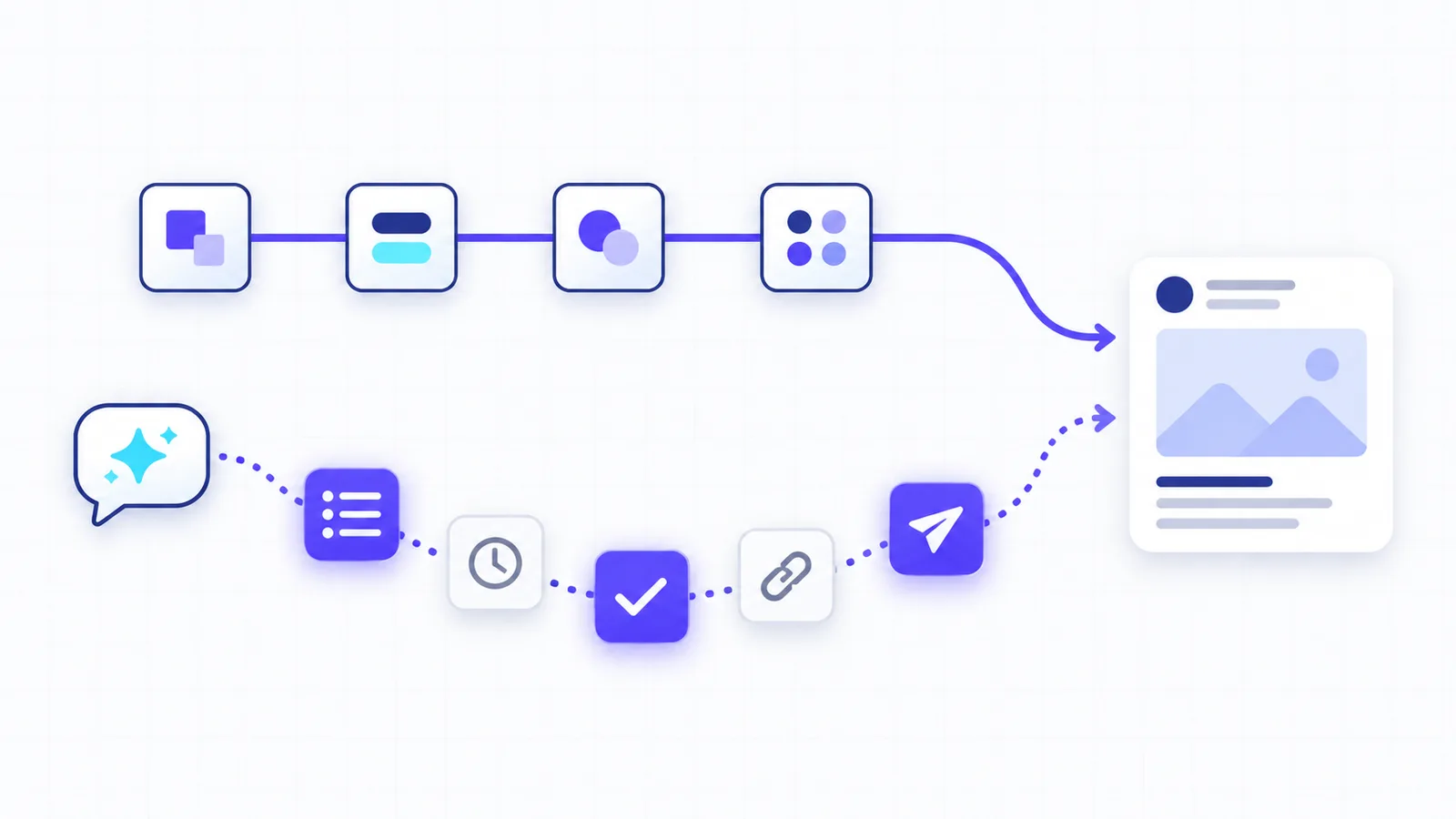
An API is a set of endpoints your code calls, in the order you wrote. MCP, the Model Context Protocol, is a standard way to give an AI assistant tools it can discover and decide to call by itself. They aren’t rivals: an MCP server usually sits on top of an API, and the right choice depends on whether a program or an AI model decides what happens next.
This guide explains both, compares them side by side, and does the same task, publishing one social post to two accounts, through SocialHelper’s REST API and through its MCP server.
What an API is
An API is a defined set of requests a program can send to another system, with fixed inputs and outputs; the letters stand for application programming interface. MDN calls it “a set of features and rules that exist inside a software program” for other software to use (MDN Web Docs). For a web service that usually means HTTP endpoints, such as POST /api/v1/posts, documented for developers. Your code chooses which endpoint to call, with which data, in what order, and handles each response.
That’s ideal when the steps are known in advance. It also means every new use needs someone to write and maintain that code.
What MCP is
The Model Context Protocol is “an open-source standard for connecting AI applications to external systems” (modelcontextprotocol.io). Its architecture has three participants (MCP architecture):
| Participant | What it is | Example |
|---|---|---|
| MCP host | The AI application that coordinates one or more clients | Claude, ChatGPT, Claude Code, VS Code |
| MCP client | A connection the host keeps open to one server | One per connected server |
| MCP server | A program that provides tools, resources or prompts | SocialHelper’s server at /mcp |
A server offers three kinds of things, which the spec calls primitives: tools are executable functions the assistant can invoke, resources are data sources it can read, and prompts are reusable templates. Messages use JSON-RPC 2.0, “a stateless, light-weight remote procedure call (RPC) protocol” (JSON-RPC 2.0 specification). They travel over stdio for a local server running on your machine, or over Streamable HTTP for a remote server, where MCP recommends OAuth for authentication.
The key difference from an API is discovery. An assistant asks a server for its tools with tools/list and gets each tool’s name, description and a JSON Schema for its input. It then decides which ones to call with tools/call, based on what you asked for.
MCP vs API at a glance
| API | MCP | |
|---|---|---|
| Who decides the calls | Your code | The AI model, from your request |
| How it learns what exists | Developers read the docs | The assistant asks the server at runtime |
| Format | Usually REST and JSON over HTTP | JSON-RPC 2.0 over stdio or Streamable HTTP |
| Authentication | API keys, OAuth, whatever the service uses | For remote servers, OAuth is recommended; keys and headers also work |
| Best for | Fixed, repeatable jobs | Tasks described in words, with judgement in between |
The same post, both ways
Here’s one task, publishing a post to two connected accounts, done through each interface. Through SocialHelper’s REST API, your code sends one request with the text and the account IDs.
curl https://socialhelper.app/api/v1/posts \
  -H "Authorization: Bearer $SOCIALHELPER_API_KEY" \
  -H "Content-Type: application/json" \
  -H "Idempotency-Key: $(uuidgen)" \
  -d '{
      "text": "Fresh out of the oven: our cinnamon rolls are back for autumn 🍂 Get them warm from 7am, while they last.",
      "accounts": [
          "ACCOUNT_ID_1",
          "ACCOUNT_ID_2"
      ]
  }'
Through MCP, you write the request in plain words, such as “post this to our LinkedIn page and Bluesky, show me first”. The assistant then works out the calls itself.
list_accountsfinds the account IDs, so nobody has to look them up.validate_postchecks each version against the platform’s limits and shows you the result.- After you approve,
create_postpublishes. Its input is the same as the REST request:text,accounts, and optionallymedia,scheduled_at,queue,overridesandidempotency_key. get_postreports the live links.
On the wire, step 3 is a JSON-RPC message like this one, with the protocol details the client adds left out.
{
  "jsonrpc": "2.0",
  "id": 3,
  "method": "tools/call",
  "params": {
    "name": "create_post",
    "arguments": {
      "text": "Our autumn menu starts today.",
      "accounts": ["ACCOUNT_ID_1", "ACCOUNT_ID_2"]
    }
  }
}
Both routes end in the same place inside SocialHelper: the same create action, the same checks against every platform, and the same rule that a post never goes out twice. The difference is who wrote the steps.
Does an MCP server need an API?
Usually, yes. Most MCP servers are a thin layer over an existing API: each tool calls one or more endpoints and returns the result in a form a model reads well. SocialHelper’s MCP tools are thin wrappers over the same actions as its REST API, so a fix or a new check reaches both at once. A local MCP server can also wrap things with no web API at all, such as files on your disk or a local database. The protocol’s collection of reference servers includes a filesystem server that does exactly that (MCP reference servers).
When to use which
- Use the API for anything that should run the same way every time: a deploy announcement from CI, a nightly report, or posting from your own app.
- Use MCP when a person asks for something in words and the steps depend on the answer, such as drafting, checking and scheduling a week of posts.
- Use both when a task starts as a conversation and settles into a pattern. Prototype it with an assistant, then move the steady part to the API, as in the release notes guide.
To connect an assistant to SocialHelper, the MCP server page lists the setup for each app, and the API docs cover the REST side.
Frequently asked questions
Is MCP replacing APIs?
No. MCP is a way for AI assistants to use services, and most MCP servers call an API underneath. Programs that don’t involve an AI model keep calling APIs directly.
Is an MCP server an HTTP server?
A remote one is: it speaks MCP over Streamable HTTP. A local MCP server usually talks to its host over stdio, the standard input and output of a process on the same machine, with no network involved.
What is the difference between a local and a remote MCP server?
A local server runs on your computer, typically for one app, and can reach your files. A remote server runs on a service’s infrastructure, serves many users, and authenticates each one, usually with OAuth.
Can I use SocialHelper with both?
Yes. The REST API at /api/v1 and the MCP server at /mcp run the same actions, so you can post from code and from an AI assistant against the same accounts.
How we checked this
The definitions and the protocol details come from the Model Context Protocol’s documentation, which we ran a fact check against on October 17, 2026. The SocialHelper examples are generated from its code: the REST request from the live API and the tool names and inputs from the MCP server, which we analyzed the same day.
If you spot something that has changed, contact us and we’ll correct it.


